Napoleon Bonaparte, a towering figure in European history, is remembered for his distinctive bicorn hat, his reputation for swift strategic thinking, and a rise from student to ruler of a vast empire. By 1815, after a series of campaigns known as the Napoleonic Wars, his impact reshaped the continent. Here are seven succinct insights into his ascent and decline.
Photo credit: Historical Images Archive/ Alamy Stock Photo
French Wasn’t His First Language
Growing up on the Corsican coast, Napoleon’s earliest language was a Corsican dialect rooted in Italian. He didn’t begin speaking fluent French until he was nine, and even after becoming emperor, his Corsican accent continued to mark him as an outsider on the French mainland.

— advertisement — Photo credit: Chronicle/ Alamy Stock Photo
The Rosetta Stone Was Discovered by One of His Soldiers
Amid Napoleon’s Egypt campaign, a soldier in his army uncovered the Rosetta Stone, a discovery pivotal to deciphering hieroglyphs. Pierre-François Xavier Bouchard, an officer under Napoleon, supervised its transfer to Cairo before the artifact found its way to the British Museum in London.

Photo credit: API/ Gamma-Rapho via Getty Images
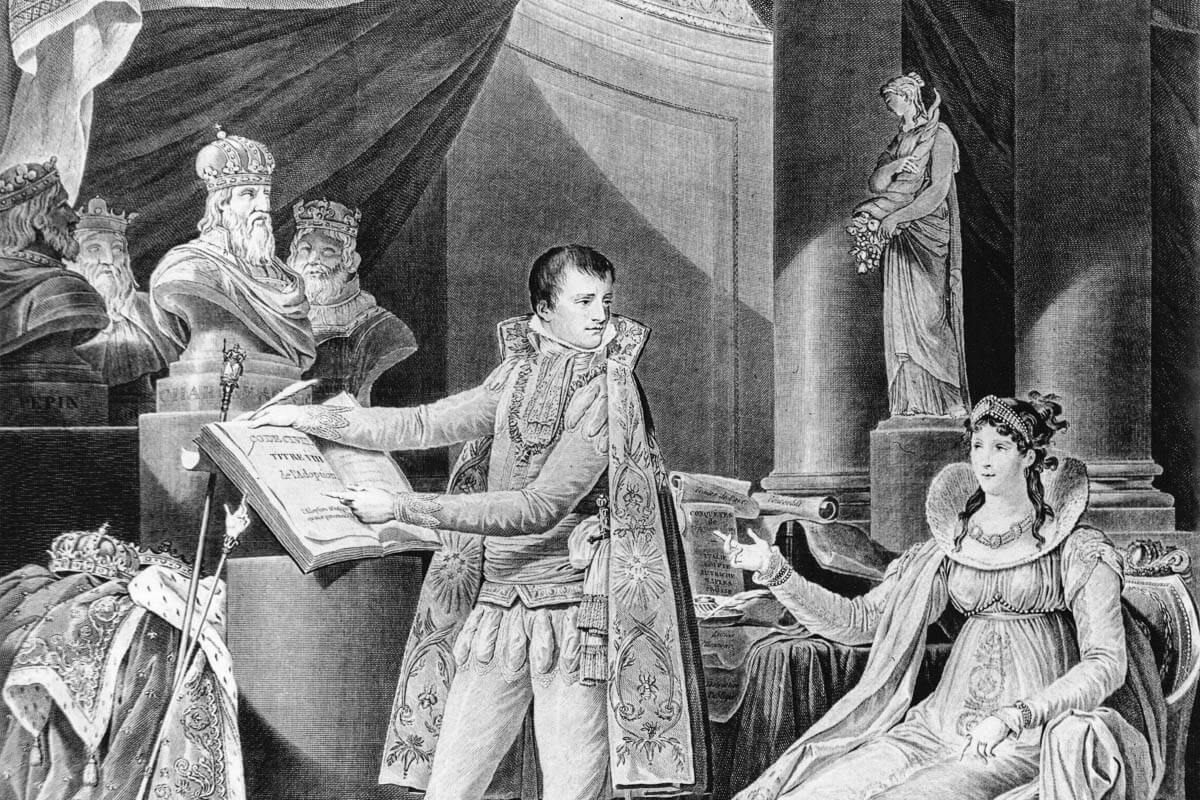
The Civil Code He Created Is Still Used Today
As Napoleon consolidated power, he introduced the Napoleonic Code, a comprehensive set of laws governing many facets of life, including property, family, and civil rights. The code’s influence endures in regions such as Belgium, Luxembourg, and Monaco.

— advertisement — Photo credit: UniversalImagesGroup via Getty Images
The “Mona Lisa” Once Hung in His Bedroom
In a striking art-patron moment, Napoleon moved Leonardo da Vinci’s Mona Lisa to his private bedchamber for personal viewing. He reportedly called the woman in the painting “Madame Lisa” and “the Sphinx of the Occident.” The artwork remained in his room for four years before being placed in the Louvre’s Grand Gallery in 1804.

Photo credit: Smith Collection/Gado/ Archive Photos via Getty Images
He Kidnapped Two Different Popes
Relations with the Vatican grew tense, leading Napoleon to forcibly relocate two popes. In 1798 he captured Pope Pius VI to support France’s position against a Vatican-aligned European coalition. He repeated the tactic in 1809 with Pope Pius VII, who remained a prisoner until Napoleon’s abdication in 1814.
Photo credit: Heritage Images/ Hulton Fine Art Collection via Getty Images

He Went From Ruling Europe to Ruling an Island of Only 12,000 People
After a devastating invasion of Russia, Napoleon abdicated in 1814 and was exiled to Elba, a small island off Tuscany with about 12,000 residents. By contrast, his 1811 empire stretched across much of Europe. His daring escape from Elba 300 days later led to a brief return to power in France.

Photo credit: Photo Josse/Leemage/ Corbis Historical via Getty Images
He Was Exiled Two Different Times to Two Different Islands
Following Napoleon’s final defeat at Waterloo, he was banished to St. Helena, a remote island in the Atlantic about 1,200 miles from the nearest mainland. There, in relative isolation and worsening health, he remained until his death in 1821.