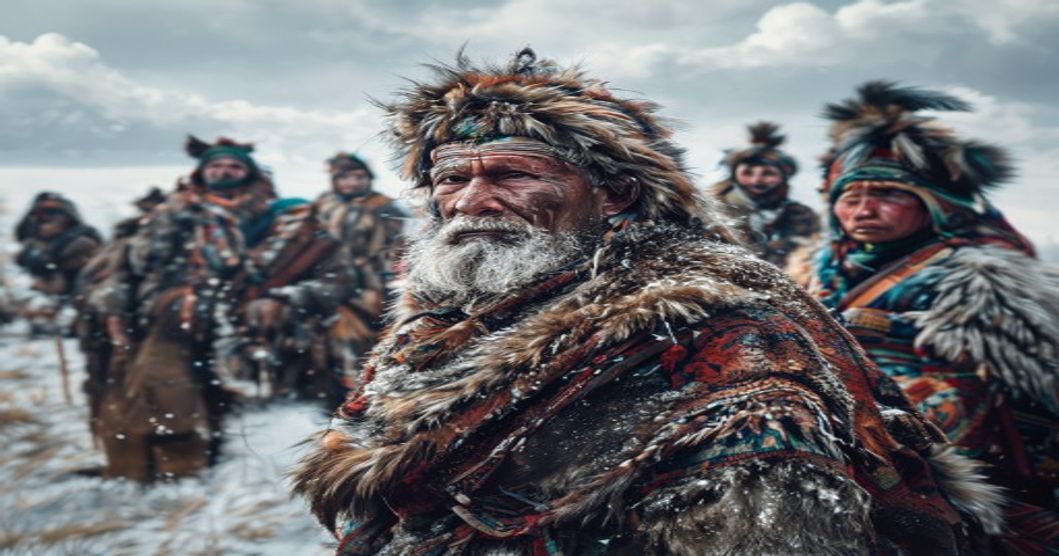
Origins and Early Settlement of the Sámi People
The Sámi people history traces back over ten thousand years, with archaeological discoveries in northern Fennoscandia confirming continuous human habitation long before medieval state borders divided the region. Genetic research indicates that the Sámi are among the few remaining indigenous populations of Europe, descending from post-glacial hunter-gatherer groups who adapted to subarctic environments during the Holocene epoch. Unlike other European ethnic groups shaped by successive agricultural invasions, the Sámi maintained distinct evolutionary pathways through isolation and environmental specialization.
Archaeological Evidence and Prehistoric Roots
Excavations across Troms, Finnmark, Lapland, and Kola Peninsula reveal bone tools, reindeer antler implements, and petroglyph sites dating to the Mesolithic period. These artifacts demonstrate sophisticated seasonal tracking systems and early domestication experiments with wild cervids. Stratigraphic analysis confirms that Sámi ancestors utilized coastal fjords during winter months while migrating inland toward taiga forests as summer approached, establishing a dual ecological strategy that defined their ancestral survival model.
Linguistic Lineage and Genetic Studies
Sámi languages belong to the Uralic family, closely related to Finnish and Estonian rather than neighboring Scandinavian tongues. Phylogenetic mapping shows that Proto-Sámi diverged approximately three thousand years ago, preserving archaic grammatical structures lost in continental Finno-Ugric branches. Modern genomic sequencing reveals unique haplogroups concentrated in northern latitudes, with measurable gene flow from ancient Siberian and European hunter-gatherer populations, confirming both deep regional continuity and controlled external contact.
The Sacred Geography of Sápmi
Sápmi represents the traditional homeland spanning across Norway, Sweden, Finland, and Russia’s Kola Peninsula. This transnational territory was never formally colonized in antiquity but functioned as a fluid cultural landscape defined by ecological zones rather than political boundaries.
Sami People History and Origins Explained: Geographic and Linguistic Foundations
Traditional Territory Across Fennoscandia
The Sami inhabit Sápmi, a region spanning northern Norway, Sweden, Finland, and Russia’s Kola Peninsula. This territory covers roughly 386,000 square kilometers of boreal forests, tundra, and mountain ranges. Historical boundaries shifted due to resource extraction and state expansion rather than fixed borders. Modern administrative lines divide the traditional landscape without erasing indigenous land claims.
Uralic Language Family Classification
Sami languages belong to the Uralic family, specifically the Finnic-Samic branch. Nine distinct dialects survive today, with Northern Sami holding the largest speaker base. Linguistic divergence occurred over millennia due to geographic isolation and contact with Scandinavian and Russian tongues. Grammatical features include extensive noun cases and vowel harmony patterns absent in Germanic languages.
Prehistoric Migration and Settlement Patterns
Early Hunter-Gatherer Communities
Archaeological evidence places Komsa culture inhabitants in coastal Fennoscandia around 9,500 BCE. These groups relied on marine resources, reindeer migrations, and seasonal fishing routes. Lithic tools and shell middens reveal sophisticated seasonal camp networks. Settlement patterns adapted to ice retreat and shifting ecological zones after the last glacial period.
Transition to Semi-Nomadic Lifeways
Reindeer domestication emerged gradually between the 12th and 14th centuries CE. Prior to this, communities managed wild herds through seasonal driving and selective killing. The shift enabled year-round mobility across vast altitudinal gradients. Lavvu structures facilitated rapid camp relocation during winter migrations.
Historical Encounters and External Pressures
Medieval Trade and Taxation Systems
Norse kingdoms imposed skatt levies on Sami communities using salt, iron, and textiles as currency. Medieval sagas document tribute exchanges but rarely acknowledge indigenous political autonomy. Russian tsars later introduced the krestovye system to monitor northern trade routes. Tax records reveal persistent economic integration despite cultural marginalization.
18th Century Border Delineation
The Treaty of Strömssöm (1751) formalized Norway-Sweden divisions across Sápmi. Border markers ignored traditional grazing corridors and sacred sites. Finnish authorities applied similar partitioning after gaining autonomy from Sweden. Cartographic divisions fractured seasonal migration routes and administrative jurisdiction.
Assimilation Policies and Cultural Suppression
Norwegian Finnemarchiseringen
The Finnmarkisering campaign targeted Sami identity through forced relocation and land confiscation. State institutions promoted Norwegian language in schools and public administration. Residential zoning laws restricted traditional camping near coastal zones. Economic dependency replaced cultural autonomy through centralized welfare distribution.
Swedish and Finnish Boarding Schools
State-run institutions removed children from families to enforce linguistic uniformity. Punitive measures included physical discipline for speaking native tongues. Curriculum erased indigenous ecological knowledge and historical narratives. Survivors documented intergenerational trauma through oral testimony and archival research.
Genetic Mapping and Ancestral Origins
Y-DNA and Mitochondrial Haplogroups
Male lineages cluster around R1a and N1c haplogroups with distinct Scandinavian and Siberian signatures. Female mtDNA shows H and V clusters common in northern Europe. Ancient DNA analysis reveals continuity with Mesolithic hunter-gatherer populations. Admixture events correlate with Bronze Age agricultural expansions.
Autochthonous vs. Exogenous Origins
Genomic studies confirm indigenous continuity dating back 4,000 years. Exogenous theories previously linked Sami to Asian migrations without archaeological support. Paleosiberian and West European Hunter-Gatherer (WHG) ancestry components dominate modern profiles. Mitochondrial diversity indicates female lineages retained prehistoric structure despite male gene flow.
Archaeological Record and Material Culture
Runic Inscriptions and Ritual Objects
Sami runic manuscripts document oral traditions using modified Scandinavian scripts. Drum artifacts display cosmological diagrams used by Noaidi practitioners. Copper and bronze ornaments indicate long-distance trade networks. Ritual deposits in bogs reflect seasonal sacrifice practices.
Rock Art and Sacred Landscapes
Alta and Vingen sites contain petroglyphs dating to 7,000 BCE. Reindeer, boats, and human figures dominate compositional themes. Geographic placement aligns with migration corridors and fishing grounds. Modern preservation efforts classify these zones as protected heritage areas.
Modern Revitalization and Legal Recognition
Constitutional Amendments and Land Rights
Norway amended its constitution in 1988 to recognize Sami cultural and economic rights. Finland established the Sámediggi with legislative oversight over cultural affairs. Sweden created a Sami Parliament in 1993 to manage language funding. International treaties mandate state support for dialect preservation and teacher training.
Language Documentation and Education
Digital archives record elder speakers using standardized orthography. University departments publish grammatical frameworks and lexical databases. Radio broadcasts and satellite programming maintain media presence across borders. Curriculum reforms integrate indigenous pedagogy into primary education.
Contemporary Political Representation
Parliamentary Structures and Electoral Districts
Sami parliaments operate as advisory bodies with budgetary authority over cultural programs. Electoral districts align with traditional migration zones rather than municipal boundaries. Cross-border cooperation facilitates joint research on grazing land management. Political advocacy targets corporate licensing for mining and wind energy projects.
Intellectual Property and Artisanal Crafts
Gákti clothing patterns function as regional identifiers rather than universal symbols. Legal frameworks restrict commercial appropriation of traditional motifs. Artisans receive state subsidies for weaving and silverwork techniques. UNESCO listings protect intangible cultural practices from market exploitation.
Ecological Knowledge and Environmental Stewardship
Reindeer Husbandry and Climate Adaptation
Seasonal grazing cycles depend on snow density and lichen availability. Warming temperatures alter migration routes and increase parasite loads. Pastoralists monitor permafrost thaw and vegetation shifts through generational observation. Co-management agreements integrate indigenous data with satellite telemetry.
Forest Management and Biodiversity
Traditional burning practices maintain habitat heterogeneity for ground-nesting birds. Controlled harvests of birch and pine support medicinal and craft industries. Conservation policies increasingly recognize indigenous monitoring as complementary to scientific surveys. Land use permits require consultation with Sámediggi representatives.
Conclusion: Legacy and Future Trajectories
Historical Continuity and Cultural Resilience
Sami history demonstrates sustained adaptation to political partition and ecological change. Linguistic preservation relies on institutional funding and digital archiving. Genetic mapping confirms deep ancestral roots independent of external colonization narratives. Modern legal frameworks secure partial autonomy while addressing corporate land pressures. Future trajectories depend on intergenerational knowledge transfer and cross-border cooperation.
Frequently Asked Questions
What is Sami People History and Origins Explained?
The history and origins of the Sámi people refer to the indigenous ethnic group native to the northern regions of Norway, Sweden, Finland, and the Kola Peninsula of Russia. Their history spans thousands of years, marked by reindeer herding, fishing, hunting, and a rich cultural heritage. The Sámi have maintained their distinct language, traditions, and identity despite centuries of assimilation policies and external influences.
Key facts about Sami People History and Origins Explained
Key facts include: the Sámi are Europe’s only officially recognized indigenous people; their languages belong to the Uralic family, not Indo-European; they traditionally practiced nomadic reindeer herding, fishing, and hunting; they have faced historical discrimination but have seen significant cultural and political revival since the 20th century; and they possess a unique spiritual tradition centered around the concept of ‘Sámi duodji’ (handicrafts) and ‘joik’ (traditional singing).