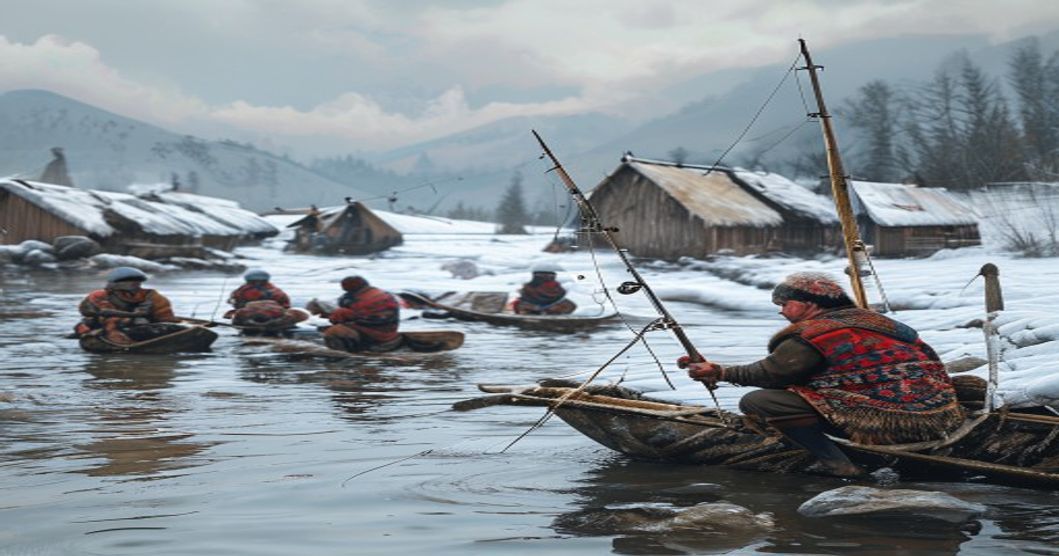
Traditional Fishing Practices of Sami People: A Complete Historical and Cultural Overview
The traditional fishing practices of the Sami people emerged from centuries of adaptation to the Arctic and Subarctic ecosystems across northern Scandinavia, Finland, and Russia. Long before mechanical equipment, Sami communities developed highly specialized techniques that synchronized with seasonal fish migrations, particularly Atlantic salmon and brown trout runs in rivers like the Tana, Anárjohka, and Muonio.
Central to their methodology was the construction of stone weirs, known locally as stuorru or guolleváddo. These structures were strategically placed across shallow river sections to guide fish into narrow channels where they could be harvested using woven nets, wooden spears, or hand baskets. The design relied on precise hydrological knowledge, allowing water flow to naturally funnel fish while maintaining ecological balance by leaving certain passages open for downstream migration.
- Tool Fabrication: Hooks and lines were crafted from reindeer antler, bird bone, and sinew. Nets utilized plant fibers such as birch bark strips and dried grasses, treated with natural oils to increase durability in cold water.
- Seasonal Rhythm: Spring fishing targeted spawning runs, while autumn efforts focused on fat accumulation before winter. Ice fishing during frozen months involved drilling circular holes and placing specialized traps beneath the ice surface.
- Cultural Transmission: Knowledge passed through direct apprenticeship. Elders demonstrated knot tying, current reading, and net mending techniques, ensuring continuity across generations without written documentation.
Spiritual and practical elements intertwined in every phase of the process. Before entering the water, fishers performed silent rituals to honor the spirit of the river and request permission from nature. Waste was minimized; scales, bones, and offal returned to the ecosystem as fertilizer or were preserved through smoking and drying for winter sustenance. These practices reinforced a worldview where resource extraction remained strictly reciprocal rather than extractive.
Historical records indicate that Sami fishing grounds operated under communal stewardship rather than private ownership. Territories were managed by local clans who regulated harvest quotas based on observable population levels and environmental conditions. This decentralized governance prevented overfishing long before contemporary conservation frameworks existed. Today, these ancestral methods inform modern sustainable fisheries initiatives across Sápmi, serving as living documentation of Indigenous ecological literacy.
Origins of Indigenous Fishing Communities in Northern Fennoscandia
The earliest evidence of Sami fishing communities in Northern Fennoscandia emerges from archaeological excavations along the coastal waters of Finnmark, the river systems of Troms and Nordland, and the inland lake networks of Lapland. Radiocarbon dating places these settlements between 8000 and 6000 BCE, coinciding with the post-glacial retreat that opened Arctic waterways for permanent habitation. Unlike later pastoralist narratives that emphasize reindeer herding, early Sami groups relied heavily on anadromous fish species, particularly Atlantic salmon, brown trout, and Arctic char. Fishweirs constructed from interwoven birch branches and whalebone stakes appear in the Tana River basin dating back to the Neolithic period. These structures demonstrate sophisticated hydrological understanding, channeling migrating fish into controlled capture zones without depleting spawning grounds.
Radiocarbon analysis of bone hooks and copper-alloy weights recovered from Bronze Age burial mounds confirms standardized manufacturing techniques transmitted through generational apprenticeships. Rock art sites across Alta and Vingen reveal consistent depictions of net frames, boat-shaped vessels, and submerged trap configurations, proving that aquatic resource management predated written Scandinavian records by millennia. Kola Peninsula Sami dialects preserve specialized terminology for water currents, ice thickness thresholds, and spawning cycle indicators, reflecting a knowledge system refined through continuous environmental observation.
- Neolithic Fishweir Construction: Interwoven birch wood and whalebone stakes created directional channels in the Tana River basin, optimizing catch rates while preserving juvenile populations for future runs.
- Seasonal Migration Cycles: Communities rotated between coastal fjords during summer salmon migrations and sheltered inlets where winter ice fishing occurred through precisely drilled shaft holes.
- Preservation Engineering: Smoke-drying kilns built from stone foundations and pine branches extended shelf life across subzero winters, enabling trade exchanges with Norse merchants at Karasjok and Kautokeino fairs.
- Resource Governance: Clan-based stewardship models regulated water rights, preventing monopolization of productive fishing sites and maintaining ecological balance across generations.
Climate shifts during the Medieval Warm Period altered fish distribution patterns, prompting adaptive modifications to trap placements and the development of salt-curing techniques imported through Baltic trade routes. Modern submerged archaeology in the Bothnian Sea and White Sea basins continues to validate oral histories regarding ancient migration corridors synchronized with spawning seasons.
Handcrafted Nets, Traps, and Spears Developed by Sami Artisans
The construction of Sami fishing equipment relies on a precise understanding of local ecology and material science. Artisans harvest reindeer sinew for its exceptional tensile strength, twisting and drying the fibers into cordage that resists rot in freshwater and saltwater environments. Birch bark serves as a waterproof lining for storage containers and trap linings, while driftwood from coastal rivers provides the structural framework for nets and spears. The weaving process follows generations of calibrated tension techniques, ensuring mesh openings remain consistent to target specific species like Arctic char, trout, and whitefish without damaging the catch.
Nets are typically cast in shallow fjords or set along river currents using weighted edges that sink rapidly. The knotless design reduces drag and prevents tangles, while seasonal adjustments account for fish migration patterns and water temperature shifts. Artisans monitor ice thickness and snowmelt cycles to determine optimal deployment windows, maximizing yield during spawning periods when fish congregate in predictable routes.
- Stone weirs are arranged in V-shaped formations across tidal channels, guiding migrating salmon into woven willow baskets that function as one-way valves.
- Tidal fish pens utilize natural rock barriers combined with interlaced branches to create enclosed holding areas that retain catch until retrieval.
- Antler-tipped spears feature barbed points carved from shed reindeer antlers, sharpened on waterworn stones and attached to flexible birch shafts balanced for precise underwater thrusting.
Sustainability remains embedded in every stage of production. Tools are designed for repair rather than replacement, with damaged sections rebuilt using matching materials from stored reserves. The Sami approach prioritizes ecological balance, leaving sufficient fish populations to reproduce while harvesting only what sustains the community. Modern conservation studies frequently reference these traditional methods as early models of selective harvesting and habitat-aware resource management.
Techniques for Harvesting Arctic Char, Trout, and Whitefish in Rivers and Lakes
Harvesting Arctic char, brown trout, and whitefish across Nordic river systems and alpine lakes requires calibrated gear deployment synchronized with species migration patterns. Traditional static gill nets utilize untreated hemp fibers dyed with local bark extracts to minimize visual detection in clear waters. Mesh dimensions follow strict graduated sizing protocols, retaining mature fish while permitting juvenile escape through precisely measured square openings. Fishers anchor these networks across confluence zones where current velocity creates natural feeding corridors, positioning the fabric perpendicular to flow direction to maximize capture efficiency without creating hydraulic blockages. Net tension is regulated through adjustable hemp toggle mechanisms that absorb sudden fish strikes while preventing fiber abrasion against submerged rocks.
- Seasonal Bait Formulation: Harvesters collect caddisfly larvae, freshwater leeches, and crushed aquatic beetles from adjacent wetlands, matching local prey density to trigger predatory strikes in thermally regulated water columns.
- Winter Subsurface Monitoring: Iron augers carve circular access points through frozen surfaces, followed by weighted tip-up apparatus featuring hand-carved wooden indicators that detect subtle line vibrations beneath the ice layer.
- Astronomical Scheduling: Deployment windows align with lunar illumination cycles and diurnal temperature gradients, as Arctic char exhibit peak vertical movement during twilight periods when surface cooling reduces metabolic stress thresholds.
Riverine operations demand precise substrate analysis and current mapping. Practitioners identify gravel spawning beds through water clarity shifts and eddy formation patterns, then secure net anchors using locally quarried stone weights that distribute pressure across sensitive riverbeds. Temporary processing stations along active waterways utilize dried birch wood smoke to preserve surplus catches, maintaining protein structure while extending storage duration. Ecological assessments demonstrate that these inherited extraction methods maintain exceptional bycatch survival rates during non-target species removal, reflecting generations of environmental calibration. Net segments follow strict replacement schedules coordinated with reproductive timelines, preventing habitat disruption and guaranteeing continuous population regeneration across traditional territories.
Sacred Sites and Ritual Offerings Linked to Sami Fishing Expeditions
Long before commercial fishing reshaped northern waterways, Sami communities structured their expeditions around deeply embedded spiritual protocols. Fishing was never treated as a mere extraction of resources but as a negotiated exchange with the natural world. Every river, lake, and coastal inlet held specific sieidi—sacred stones or geological formations that functioned as portals to the spirit realm. Before casting nets or setting traps, fishermen would pause at these designated sites, placing offerings of dried fish, reindeer fat, woven cloth, or later, liquor. These gestures were practical negotiations for permission and favor from the vuelie (nature spirits) guarding the waters.
The timing of fishing expeditions aligned with lunar cycles and seasonal migrations, but spiritual observance dictated immediate action. A sudden change in wind or an unexplained ripple on still water was interpreted as a warning to halt work and perform a quick offering. Camps near spawning grounds were treated with strict reverence. Nets were never dragged through known breeding zones without first leaving a portion of the catch back into the water. This practice maintained ecological balance while reinforcing communal respect for reproductive cycles. Ritual specialists, often older community members familiar with ancestral songs (joik), would lead pre-expedition gatherings where participants recited invocations to Mánnu (the moon deity) and river guardians.
- Sacred sites were mapped through oral tradition rather than written charts, passed down via generational storytelling and marked by specific rock formations or tree roots.
- Offerings followed seasonal patterns: spring expeditions received grain and birch bark, while autumn journeys demanded cured meat and pine resin.
- Breaking ritual protocol was believed to bring poor catches, equipment failure, or illness, reinforcing compliance through lived consequence rather than doctrine.
These practices embedded sustainability into spiritual law. By framing ecological limits as sacred boundaries, Sami fishing communities preserved fish stocks long before modern conservation science articulated the need. The physical markers of these sites still appear in remote Sápmi landscapes, serving as tangible links between ancestral practice and contemporary environmental stewardship.
Weather Patterns and Ice Conditions Dictating Traditional Catch Windows
The Sami communities operating across the Fennoscandian tundra and taiga zones rely on precise environmental reading to synchronize their fishing activities with natural cycles. Winter ice development follows a predictable yet highly localized progression across frozen waterways. Clear, calm winds allow thick, stable ice to form over lakes and slow-moving rivers, creating safe platforms for drilling traditional holes. When temperatures plummet below twenty degrees Celsius, the ice density increases rapidly, enabling fishermen to access deeper water columns where Arctic char and brown trout congregate during winter dormancy. The thickness of the snowpack above the ice acts as a critical insulator; heavy snow slows freezing, while wind-scoured surfaces accelerate it. Sami fishers historically marked safe zones using stone cairns and carved wooden poles when ice reached a minimum threshold of twelve centimeters for single-person access.
- Spring Thaw Dynamics: Rapid warming causes surface meltwater to pool on the ice, increasing slip hazards and weakening structural integrity. Traditional catch windows close abruptly as ice fractures and drainage channels form over submerged vegetation and fish migration routes. Fishers monitor air temperature fluctuations and solar radiation patterns to anticipate break-up dates with precision.
- Fall Freeze Indicators:Oral Histories Passing Down Expertise from Elders to Young Fishers
The transmission of indigenous fishing knowledge within Sami communities operates through intergenerational oral encoding rather than archival documentation. Elders function as living repositories, embedding centuries of hydrological observation, seasonal migration tracking, and microclimate interpretation into narrative structures that younger generations internalize through contextual immersion and repetitive practice. This pedagogical framework bypasses formal instruction, situating technical precision within communal storytelling, rhythmic work chants, and extended field expeditions along river corridors and frozen coastal basins.
Achieving proficiency in traditional Sami fisheries demands continuous environmental calibration that static references cannot replicate. Apprentices develop tactile literacy by assessing ice stability through acoustic feedback, locating spawning beds via water turbidity gradients and subsurface current patterns, and crafting split-pole gear from seasonally harvested willow and spruce. These competencies emerge through sustained exposure during multi-day journeys where adaptive decision-making under shifting conditions replaces theoretical abstraction.
- Ecological Calendar Alignment: Knowledge keepers synchronize fishing intervals with lunar cycles, aurora intensity, and caribou movement corridors to prevent overharvesting and maintain cross-habitat resource equilibrium.
- Gear Construction Mnemonics: Net-weaving sequences are preserved through melodic verses that encode knot configurations, mesh tension tolerances, and species-specific repair protocols.
- Landscape Signposting Systems: Navigational cues rely on moss distribution vectors, avian flight paths over pressure ridges, and historical hearth ash deposits that delineate secure crossing routes during rapid thaw periods.
This cognitive architecture persists through active application rather than preservation initiatives. When younger practitioners replicate ancestral casting trajectories or reconstruct ice shelters using conventional lash techniques, they activate spatial reasoning networks that accelerate environmental assessment and risk mitigation. The methodology simultaneously reinforces place-based resource governance and interdependent management frameworks that have sustained Sami subsistence economies across subarctic and Arctic transition zones for generations.
Contemporary Conservation Efforts Safeguarding Sami Fishing Heritage
Modern preservation frameworks for Sami fishing traditions operate through integrated ecological monitoring and community-driven governance models. Indigenous cooperatives across Finnmark, Troms, and Lapland regions have established co-management agreements with national fisheries authorities, ensuring traditional catch limits align with contemporary stock assessments. These arrangements prioritize species like Arctic char, Atlantic cod, and whitefish while embedding historical seasonal migration patterns into modern quota systems.
Traditional ecological knowledge now functions as a core component of regional biodiversity strategies. Sami fishers document ice thickness variations, spawning ground shifts, and water temperature fluctuations using generational observation logs that complement satellite telemetry data. This hybrid approach has enabled early detection of ecosystem stressors, particularly in fjord systems where industrial trawling previously disrupted benthic habitats.
- Community-led hatchery programs restore native fish populations while preserving genetic lineages tied to ancestral waterways
- Digital mapping initiatives catalog historical fishing sites, protecting them from commercial development and infrastructure expansion
- Youth apprenticeship networks transmit pole-and-line techniques, net-mending protocols, and seasonal navigation methods through structured mentorship cycles
- Policy advocacy coalitions secure legal recognition of customary fishing rights within European Union fisheries management directives
Material conservation also receives targeted intervention. Artisans collaborate with marine biologists to develop biodegradable net materials that mimic historical hemp and wool construction, reducing ghost fishing incidents while maintaining catch efficiency. Educational curricula in northern vocational schools now integrate traditional gear fabrication with modern sustainability certifications, creating a pipeline of practitioners who navigate both cultural continuity and regulatory compliance.
Funding mechanisms rely on cross-border Indigenous development grants combined with municipal eco-tourism revenue sharing. These financial structures support real-time water quality sensors deployed at critical spawning zones, fund legal representation for territorial fishing claims, and sponsor annual knowledge exchange forums where elder fishers validate contemporary monitoring data against historical catch records. The resulting framework demonstrates how adaptive management can sustain cultural practices without compromising ecosystem resilience.
School Curricula and Workshops Reviving Ancient Sami Fishing Skills
Formal education systems across the Arctic regions of Norway, Sweden, and Finland have systematically integrated Sami fishing heritage into standard curricula. Regional education boards now mandate indigenous knowledge modules for middle and high school students operating within traditional Sami territories. These programs operate on a dual framework that pairs ecological science with ancestral practice. Students study migratory patterns of Atlantic cod, Arctic char, and whitefish while simultaneously learning how historical harvest methods aligned with natural reproductive cycles.
Classroom instruction emphasizes sustainable harvesting principles long before practical application begins. Teachers utilize historical catch logs, oral recordings, and archaeological findings to reconstruct seasonal fishing calendars. Learners analyze water temperature thresholds,
Integration of Traditional Methods with Scientific Stock Management
The Sami fishing communities have maintained detailed ecological records across generations, tracking fish migration routes, spawning timings, and water temperature fluctuations through direct environmental observation. Modern stock assessment models incorporate these historical baselines to calibrate population dynamics with greater precision. When biologists deploy acoustic telemetry or conduct stratified trawl surveys, they cross-reference findings against indigenous seasonal calendars that document reproductive cycles over centuries. This layered data approach reduces uncertainty in recruitment estimates and improves the accuracy of biomass projections.
Quota allocation systems in northern Scandinavian waters now utilize community-kept catch registries alongside government monitoring reports. Historical harvest data provides long-term trend analysis that statistical models alone cannot capture. Managers apply these combined datasets to establish dynamic closure periods, adjusting fishing windows before stock depletion triggers occur. Traditional gear specifications, including mesh dimensions and net placement techniques refined over decades, align closely with contemporary selectivity standards. Scientific validation occurs through comparative studies that measure traditional catch composition against laboratory growth curves and genetic sampling results.
- Joint monitoring stations deploy hydrological sensors alongside elder fishers who interpret ice formation patterns and current shifts
- Digital mapping platforms synchronize real-time catch coordinates with satellite sea surface temperature feeds
- Co-management councils require equal representation from research institutions and indigenous fishing cooperatives during assessment reviews
- Adaptive harvest controls adjust automatically when traditional ecological indicators signal spawning ground disturbances
Regulatory frameworks mandate collaborative authorship on stock evaluation documents, ensuring indigenous knowledge systems carry equivalent weight with mathematical modeling outputs. Continuous feedback loops operate between research vessels and local fishing stations, enabling rapid response to climate-driven ecosystem changes. Spatial management strategies benefit from hybrid mapping techniques that overlay historical fishing grounds with modern habitat suitability models. This integrated approach maintains population stability while preserving cultural fishing practices, creating a resilient framework for long-term resource sustainability.
The Lasting Impact of Traditional Fishing Practices of Sami People on Arctic Sustainability
The Sami fishing tradition operates as a calibrated ecological system, where harvesting rhythms align precisely with natural reproductive cycles of Arctic and sub-Arctic fish stocks. Generations of coastal and inland communities developed granular knowledge of salmonid migration corridors, trout spawning grounds, and whitefish bed formations. This indigenous ecological knowledge functions as a decentralized monitoring network, identifying subtle shifts in water temperature, ice cover duration, and prey availability long before instrumental records capture them.
- Seasonal Harvest Windows: Fishing activity restricts to specific periods when fish populations exhibit natural recovery phases, preventing spawning ground degradation.
- Selective Gear Deployment: Traditional drift nets and woven traps utilize mesh sizes that allow juvenile specimens to escape, maintaining age-class diversity within stocks.
- Ecosystem Feedback Loops: Waste processing techniques return nutrient-rich organic matter to coastal waters, supporting benthic food webs and secondary productivity.
Modern Arctic sustainability frameworks increasingly validate these practices through comparative stock assessments. Research demonstrates that regions maintaining indigenous fishing protocols exhibit higher resilience against climate-driven anomalies such as accelerated permafrost thaw, altered river discharge patterns, and invasive species pressure. Quantitative analyses reveal that traditional catch dispersion reduces localized habitat compaction while preserving genetic heterogeneity across fragmented river networks. The Sami approach does not isolate fisheries from broader watershed dynamics; it treats aquatic habitats as interconnected systems where terrestrial runoff, riparian vegetation, and fish population health remain mutually dependent.
Contemporary management structures face friction when external regulations impose fixed quotas without accounting for microclimatic variations across traditional territories. However, hybrid governance models that integrate indigenous observation data with satellite telemetry and hydrological modeling have proven effective in stabilizing commercial and subsistence catches alike. Policy integration of these historical methods continues to influence regional conservation strategies, demonstrating that culturally embedded harvesting techniques remain viable models for long-term ecological stability. Long-term monitoring confirms that communities preserving these practices maintain baseline biodiversity metrics that serve as reference points for ecosystem restoration projects across the circumpolar north.
Frequently Asked Questions
What is Traditional Fishing Practices of Sami People?
The traditional fishing practices of the Sami people refer to the indigenous, sustainable methods used by the Sámi communities across northern Scandinavia and Russia for centuries. These practices are deeply intertwined with their culture, seasonal migrations, and close relationship with rivers, lakes, and coastal waters. Traditional techniques include hand-line fishing, use of woven willow traps, ice fishing during winter, and specific knowledge of fish migration patterns, particularly for species like salmon, trout, and whitefish.
Key facts about Traditional Fishing Practices of Sami People
Key facts include: (1) Fishing has historically been a complementary livelihood alongside reindeer herding, farming, and hunting; (2) Tools were crafted from natural materials like wood, bone, antler, and woven plant fibers; (3) Seasons dictated fishing activities, with spring runs for salmon being especially significant; (4) Traditional knowledge emphasized sustainability, ensuring fish populations remained healthy for future generations; (5) Much of this heritage is preserved today through cultural museums, folk practices, and efforts to protect indigenous fishing rights.