The Origins and Purpose of the Colossus of Rhodes
The Colossus of Rhodes stands as one of the most enduring symbols of ancient engineering, commissioned to commemorate the successful defense of the island against Demetrius Poliorcetes. Following a prolonged siege in 305 BC, the Rhodians sought divine gratitude from Apollo, the sun god, and vowed to sell their abandoned siege equipment to fund a monumental bronze statue.
Commissioning After the Siege of 305 BC
The decision to erect the Colossus of Rhodes emerged directly from military strategy and religious tradition. The Rhodians strategically dismantled Demetrius’ siege towers, catapults, and fortifications, auctioning the scrap metal for approximately 300 talents of silver. This substantial fortune was allocated to Chares of Lindos, a prominent student of Lysippos, who oversaw the project for over a decade. The statue’s dedication coincided with the annual Helios festival, reinforcing Rhodes’ political autonomy and maritime dominance in the Hellenistic Mediterranean.
Architectural Design and Construction Process
Chares employed advanced metallurgical techniques typical of the late Classical period. The bronze Colossus of Rhodes was constructed using a wooden armature reinforced with iron tie rods, which provided structural integrity while allowing the bronze plates to be hammered into place. Workers gradually built the statue from the base upward, utilizing internal ramps and scaffolding systems that have since inspired modern architectural analysis. The fabrication required over 13 years, concluding around 280 BC when a grand ceremony unveiled the monument.
Key Facts About the Statue’s Dimensions and Craftsmanship
Historical records indicate that the Colossus of Rhodes dimensions were approximately 70 cubits tall, equivalent to roughly 30 meters or 98 feet. This made it one of the tallest statues in the ancient world, rivaling contemporary monumental constructions.
Material Composition and Structural Engineering
The bronze Colossus of Rhodes combined copper, tin, and trace amounts of lead to achieve durability and a lustrous finish. Ancient metallurgists cast the statue in sections before welding them together, a method that minimized thermal stress during cooling. The internal iron framework distributed weight efficiently across a stone pedestal, while the hollow core allowed for ventilation and reduced overall mass. Engineers today note that the statue’s proportions accounted for wind resistance, a critical consideration given Rhodes’ exposed coastal location.
Placement and Daily Significance in Ancient Rhodes
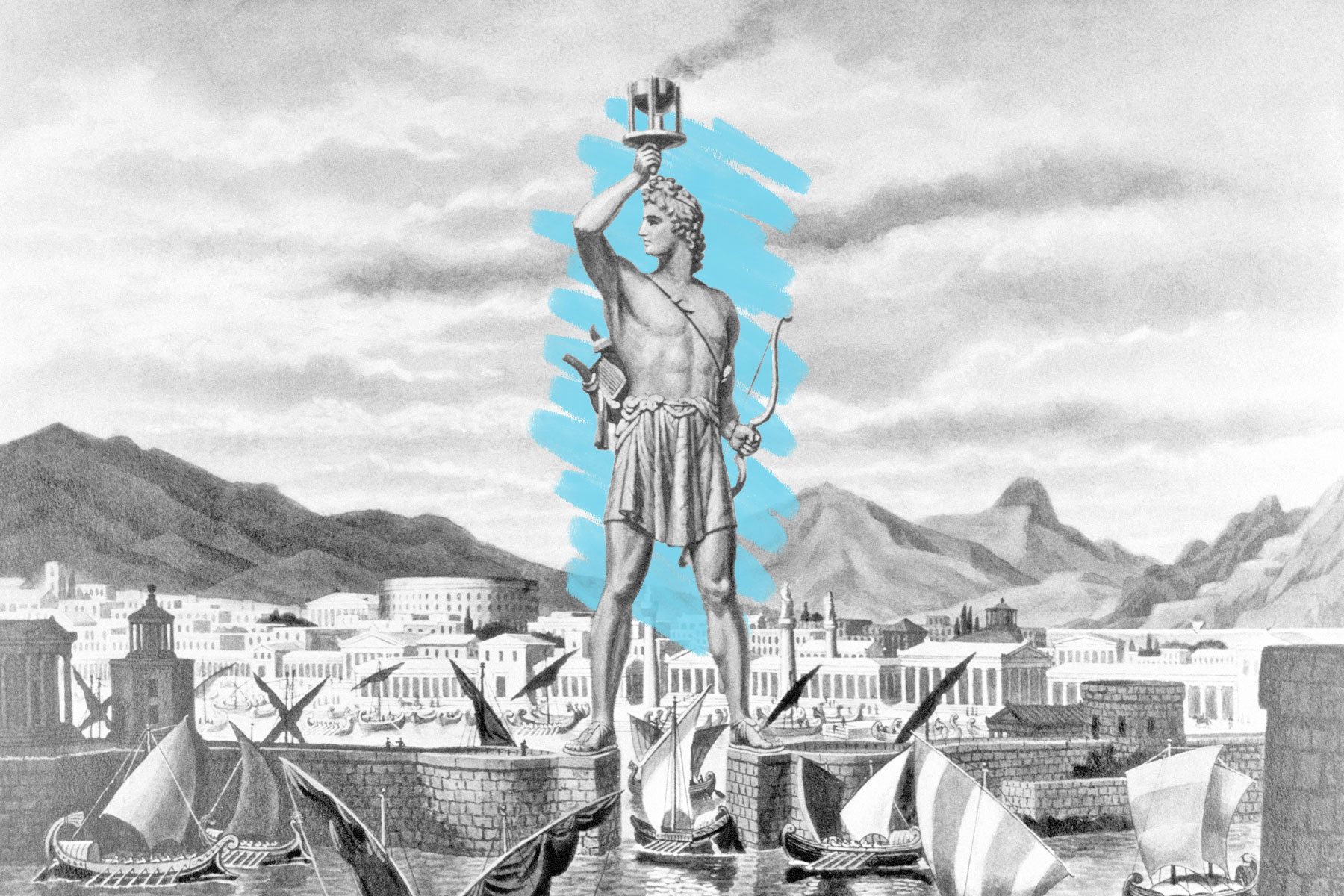
The monument stood at the entrance of Mandraki Harbor, guiding merchant vessels and asserting Rhodian naval supremacy. Unlike later interpretations depicting the statue straddling the harbor mouth, archaeological consensus confirms it occupied a single foundation near a temple dedicated to Helios. The Colossus of Rhodes functioned as both a religious icon and a civic landmark, featuring in trade contracts, coinage, and diplomatic correspondence throughout the Hellenistic era.
The Decline and Destruction of the Colossus of Rhodes
Despite its architectural brilliance, the Colossus of Rhodes endured a relatively brief existence. Geological instability and seismic activity in the eastern Mediterranean ultimately dictated its fate.
The 226 BC Earthquake That Toppled the Statue
A severe earthquake near Rhodes in 226 BC compromised the statue’s structural foundation, causing it to fracture at the knees and collapse. Ancient sources describe the monument lying on the ground for nearly nine centuries, its massive bronze segments remaining visible to travelers. The seismic event likely exceeded magnitude 7.0, exploiting the statue’s narrow base and high center of gravity. Local authorities declined reconstruction efforts due to an oracle’s warning that Apollo had rejected the offer to rebuild.
Preservation Attempts and Final Demise
The fallen Colossus of Rhodes fragments remained intact until 654 AD, when Arab forces under Muawiyah I captured Rhodes. Historical accounts state that merchant traders dismantled the wreckage over 900 camels to transport the bronze to Syria for smelting. This systematic scrapping marked the permanent loss of the original monument, though its legacy persisted through medieval manuscripts and Renaissance artistic interpretations.
Origins and Construction of the Colossus of Rhodes
The Historical Context and Commission
After repelling the prolonged siege of Demetrius Poliorcetes in 305 BC, the Rhodians sold the abandoned Greek siege equipment for a substantial fortune. They dedicated these funds to honor Helios, their patron deity, commissioning a colossal bronze statue that would eventually become one of the Seven Wonders of the Ancient World. The sculptor Chares of Lindos, a student of the renowned Lysippos, was appointed to
The Colossus of Rhodes rose to greet ships at the harbor for about five decades before nature and time conspired to bring it down. Though estimates vary, the statue’s brief life in the annals remains a stark contrast to the enduring legacy of other wonders. Its existence began in the aftermath of a siege on Rhodes in 305 BCE, when Demetrius I’s campaign failed and his army withdrew, leaving behind supplies that the city later sold for profit.
Rhodian authorities commissioned a grand tribute to Helios, the sun god who protected Rhodes, entrusting the project to Chares of Lindos, a renowned Greek sculptor. Construction spanned roughly twelve years, from about 292 BCE, and the statue was conceived as a monumental figure standing near the harbor’s eastern shore. The masterwork was likely forged from iron and stone, then clad in bronze to give it a radiant appearance.
For roughly fifty years the Colossus stood watch over the harbor, a beacon of Rhodian ingenuity. Its fate changed when a powerful earthquake struck the region, toppling the colossal sculpture around 226 BCE. In the centuries that followed, the remains were slowly dispersed, and by 654 CE, Arabian forces had gathered what was left and sold it. Legend holds that transporting the scattered debris required more than 900 camel loads.