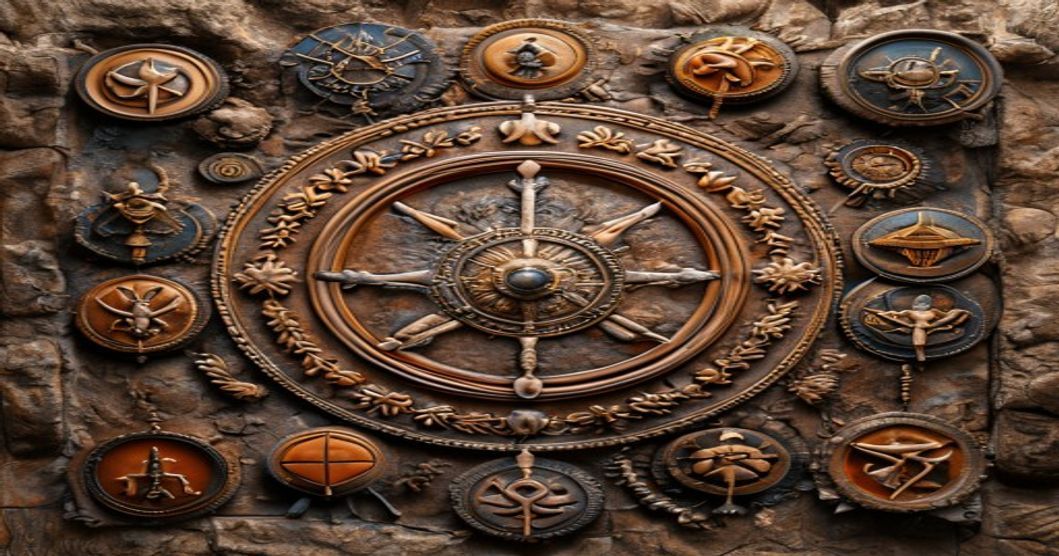
The Origins of Semitic Sacred Iconography
Semitic iconography emerged from the linguistic and cultural crucible of the ancient Near East, where early Semitic-speaking populations developed visual systems that functioned as theological statements, cosmological maps, and apotropaic devices. These sacred symbols operated across millennia, adapting to shifting political landscapes while preserving core metaphysical concepts.
Ancient Writing Systems as Visual Symbols
The developmental trajectory from proto-Sinaitic script to the standardized Phoenician alphabet demonstrates how alphabetic characters retained potent symbolic weight. Early Semitic scribes did not separate orthography from iconography; each glyph carried phonetic value and sacred resonance. Temple archives at Ugarit and archival deposits in Mari reveal that religious compositions were frequently accompanied by ritual diagrams, where divine names and cosmic forces were rendered through stylized marks rather than figurative representation.
Key Geometric Motifs in Early Semitic Art
Circles, spirals, and interlaced meanders dominate early Semitic sacred iconography. The circle encoded celestial cycles and divine eternity, while the spiral represented generative life force and agricultural renewal. Bronze Age amulets and cult stands feature geometric patterns that map cosmic order onto material objects. These forms were never arbitrary decoration; they functioned as theological architectures that structured ritual space and communicated metaphysical principles.
Decoding Major Semitic Symbols
The Wheel of Anath and Early Near Eastern Crosses
Long before Christian liturgical adoption, the Semitic cross functioned as a solar and cosmic emblem. The wheel-in-circle motif, frequently linked to the goddess Anath in Ugaritic hymns, represented divine sovereignty, celestial navigation, and cyclical renewal. Archaeological excavations at Canaanite temple platforms demonstrate that these symbols marked sacred thresholds and aligned ritual orientations with solstitial and equinoctial alignments.
The Hebrew Tetragrammaton and Divine Names
Within ancient Hebrew symbolism, the visual representation of YHWH transitioned from strict aniconic tradition to symbolic abstraction. While early Israelite theology prohibited graven images, later Jewish mystical and folk traditions employed letter-based iconography as theological infrastructure. The Tetragrammaton appeared on lead amulets, synagogue mosaics, and ritual vessels as a protective seal, with each consonant mapped to elemental forces and divine attributes. In this framework, the arrangement of sacred characters constituted a visual theology where form itself mediated presence.
Phoenician and Punic Sacred Marks
The Tanit symbol, characterized by a triangular torso topped with an extended horizontal bar and flanked by outstretched arms, dominated Carthaginian and North African religious practice. This emblem likely synthesized lunar symbolism, fertility cults, and celestial protection. Similarly, the Baal Hand (ḥamza) motif, extensively carved into temple lintels, household shrines, and necropolis stelae, served as a primary apotropaic device. Punic iconography consistently blended abstract geometry with anthropomorphic suggestion, reflecting a theological system where divine agency was channeled through symbolic form rather than literal depiction.
Religious Evolution and Symbolic Transformation
From Polytheistic Emblems to Monotheistic Abstraction
The theological shift from ancient Near Eastern polytheism to Monotheistic Semitic traditions fundamentally restructured sacred iconography. As doctrinal frameworks tightened, visual symbols underwent rigorous reinterpretation. Crosses previously tied to solar deities were recontextualized within covenantal theology. Geometric patterns that once mapped pantheon hierarchies became expressions of divine unity and transcendence. This transformation illustrates how Semitic religious symbolism adapted doctrinally without abandoning its structural and semiotic foundations.
Cross-Cultural Symbol Migration in the Ancient Near East
Semitic symbols rarely operated in isolation. Trade networks, military campaigns, and diaspora movements facilitated the continuous exchange of sacred motifs across Mesopotamia, Egypt, Anatolia, and the Mediterranean basin. The Phoenician sacred iconography of the lotus, palm, and rosette entered Egyptian temple art, while Ugaritic storm god imagery influenced early Canaanite royal seals and administrative bullae. This persistent semiotic migration confirms that Semitic visual theology functioned within a dynamic Near Eastern symbolic ecosystem rather than a closed cultural system.
Archaeological Evidence and Modern Interpretations
Epigraphic Sources and Material Culture
Contemporary decoding of Semitic symbols meanings relies on stratified epigraphic corpora, including temple inscriptions, necropolis stelae, metallurgical artifacts, and ritual containers. Lead amulets from the First Temple period preserve glyph sequences that merge phonetic orthography with protective symbolism. Seal impressions reveal how administrative authority and religious legitimacy intersected through shared iconographic vocabularies. Each artifact provides empirical data for reconstructing ancient Semitic theological visuality.
Scholarly Consensus on Sacred Semitic Iconography
Modern academia emphasizes that sacred iconography in Semitic cultures cannot be accurately interpreted through later religious or anachronistic lenses. Decoding requires comparative linguistics, stratigraphic analysis, and cross-cultural semiotics. Researchers now prioritize contextual reading over isolated symbol extraction, acknowledging that a single motif could shift meaning across dynasties, geographic regions, and theological movements. This method
Frequently Asked Questions
What is Sami Spiritual Symbols and Meanings?
Sami spiritual symbols and meanings refer to the sacred iconography, rituals, and symbolic representations used by the indigenous Sami people of northern Scandinavia and Russia. These symbols, such as drum patterns, runestones, and motifs like the reindeer, sun wheel, and bear, embody their shamanistic beliefs, cosmology, and deep connection to nature.
Key facts about Sami Spiritual Symbols and Meanings
Key facts include: (1) The Sami noaidi (shaman) used a sacred drum inscribed with symbols to navigate spiritual journeys and diagnose illnesses. (2) Symbols often depict the three realms of Sami cosmology: the upper world of gods, the middle world of humans, and the lower world of spirits. (3) Many traditional symbols were suppressed during Christianization but have experienced a cultural revival in modern Sami art and identity. (4) Animals like the reindeer, bear, and fox hold profound spiritual significance, representing guidance, strength, and transformation.