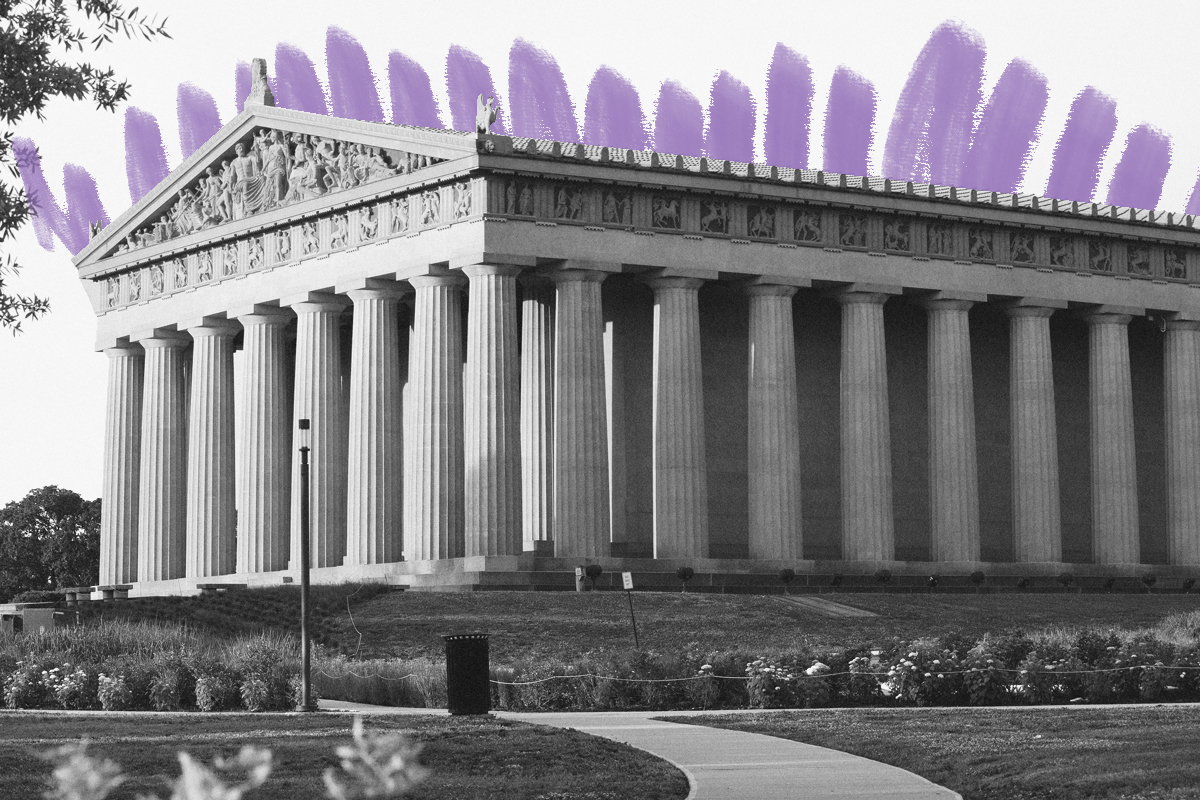
The Origins of the Full-Scale Parthenon Replica in the U.S.
The only full-scale replica of the ancient Greek temple standing on American soil is located in Nashville, Tennessee. Conceived for the 1897 Tennessee Centennial and International Exposition, the structure was initially built as a temporary pavilion using plaster and brick to celebrate the state’s hundredth anniversary. Unlike ephemeral fairgrounds architecture, local promoters recognized the cultural value of the design and initiated a permanent conversion in 1920. The transformation utilized steel reinforcement and concrete, techniques that positioned the Nashville Parthenon as an early pioneer in American reinforced concrete construction.
Architect Alfred E. Engle designed the original temporary framework under the supervision of William Sidney Pittman, a prominent educator who secured funding from the state legislature. The decision to preserve the monument permanently transformed Nashville’s urban landscape and established a unique cross-cultural architectural landmark. Today, the structure serves as a central reference point for scholars studying classical architecture adaptations in modern America.
Architectural Engineering and Construction Details
Structural Design and Materials
The Nashville Parthenon replica measures exactly 228 feet in length, 101 feet in width, and 70 feet in height, matching the original Athenian Acropolis temple’s dimensions. Early construction relied on a steel skeleton encased in concrete, an innovative approach that provided seismic resilience absent in ancient stone masonry. The foundation utilizes deep caisson piles driven into the bedrock of Centennial Park, ensuring stability across fluctuating groundwater levels and soil composition changes.
Fidelity to Ancient Greek Specifications
Engineers meticulously replicated the original temple’s Doric colonnade, featuring 46 exterior columns arranged in an octastyle front and rear elevation with seventeen columns along each flank. The column shafts employ entasis, a subtle convex curvature designed to counteract optical illusions of concavity. Interior chambers include the cella and the opisthodomos, though modern modifications accommodate climate control and visitor circulation. Replicas of the pedimental sculptures by Phidias and metope reliefs adorn the exterior, though contemporary restorations prioritize archaeological accuracy over Victorian-era artistic interpretations.
Historical Milestones and Preservation Efforts
A catastrophic fire in 1974 destroyed the interior plaster walls and damaged the roof system, prompting a comprehensive restoration that lasted until 1990. The reconstruction replaced compromised concrete sections with high-performance mixtures containing silica fume for enhanced durability. Structural engineers installed vibration dampeners and monitored load distribution across the column grid to prevent stress fractures caused by thermal expansion.
Modern conservation protocols employ non-invasive scanning technologies, including photogrammetry and ground-penetrating radar, to track material degradation. UV-resistant coatings protect exterior limestone facades from acid rain erosion, while interior temperature regulation maintains optimal humidity levels for the Phidias-inspired gold and ivory chryselephantine statue of Athena. Museum curators rotate educational exhibits within the naos, preserving architectural integrity while sustaining public engagement.
Cultural Impact and Educational Significance
The Nashville Parthenon functions as both a municipal icon and an active academic resource. Architecture programs utilize the site for structural analysis, while classical studies departments conduct comparative research on Hellenistic design principles versus American engineering adaptations. Tourism metrics consistently rank the replica among Nashville’s top cultural destinations, generating substantial economic activity for surrounding historic districts.
Unlike European replicas that prioritize historical documentation, this U.S. installation emphasizes functional adaptation. The integration of modern accessibility infrastructure, acoustic optimization for lectures, and reinforced load-bearing capacities demonstrates how classical forms can be successfully contextualized within contemporary municipal frameworks. Researchers frequently cite the Nashville structure as a case study in sustainable heritage preservation, proving that exact-scale architectural replication remains viable when supported by rigorous engineering standards and continuous maintenance funding.
The Parthenon — an ancient Greek temple built in Athens, Greece, between 447 and 432 BCE — is one of the most famous landmarks in the world. But many people don’t realize that a full-scale replica was built far across the world in Nashville, Tennessee, to celebrate the state’s Centennial Exposition in 1897. Nashville had earned the nickname “the Athens of the South” due to its commitment to culture and higher education, and opted to honor the moniker by recreating one of ancient Greece’s most famous landmarks.
At the time, the Parthenon in Greece had fallen into disrepair, and organizers in Tennessee aimed to replicate the building as it looked in its heyday. Crews laid the first stone in 1895, and worked for two years to construct the many pillars and other features of the 65-foot-tall temple. While the exterior of the final product was an exact replica, the building’s interior featured a different layout than its Greek counterpart, and was used to display the many paintings and sculptures that were acquired for the exposition.
Initially, Nashville’s Parthenon was built using temporary materials and the plan was for it to be destroyed after the event. However, it was beloved by locals, so the city decided to rebuild the landmark with permanent materials. The structure reopened in 1931, though it still lacked an important original feature: the 42-foot-tall statue of the goddess Athena, for whom the original Parthenon was dedicated. Nashville commissioned work on the statue in 1982 and it was unveiled in 1990. In 2002, the statue was gilded and painted, adding the final touches to the replica.