Origins and Early Dispersal of the Sámi People
The Sámi migrations into northern Fennoscandia represent one of the most complex demographic shifts in post-glacial Europe. Genetic and archaeological records indicate that ancestral Sámi populations began consolidating in the boreal and subarctic zones between 8000 and 4000 BCE, following the retreat of the Weichselian ice sheet. Early groups were primarily hunter-gatherer communities who tracked migratory caribou herds across emerging tundra landscapes, utilizing sophisticated stone tools and watercraft adapted to rapidly thawing permafrost regions.
Prehistoric Roots and Genetic Lineages
Molecular anthropology confirms that the ancient Sámi settlement pattern emerged from a dual ancestry model. The foundational lineage traces back to Western Hunter-Gatherers (WHG) who expanded northward after the Last Glacial Maximum, while a secondary influx originated from Eastern Hunter-Gatherers (EHG) moving across the Baltic basin. Modern genomic sequencing reveals that Sámi genetic continuity with Bronze Age populations in Norway and Finland exceeds 90%, demonstrating remarkable demographic stability despite centuries of external cultural pressures.
Environmental Drivers of Northern Migration
Climatic oscillations during the Holocene fundamentally dictated Sámi movement. The Boreal and Atlantic periods (8500–4000 BCE) triggered rapid vegetation shifts from birch woodland to pine-dominated taiga, forcing populations to follow ecological corridors toward higher latitudes. Subsequent cooling phases, particularly the Subboreal climatic optimum, expanded tundra ecosystems across the Scandinavian Mountains and Kola Peninsula, creating ideal conditions for subarctic resource exploitation and establishing the geographical boundaries of traditional Sámi territories.
Ancient Settlement Patterns Across Fennoscandia
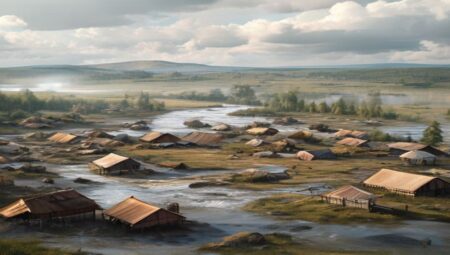
The spatial distribution of prehistoric Sámi sites reveals a highly adaptive settlement model that balanced seasonal mobility with strategic permanent locations. Archaeological surveys across Troms, Finnmark, Lapland, and Murmansk identify three primary territorial zones: coastal fjord networks, inland river valleys, and high-altitude mountain passes. Each zone functioned as a specialized ecological niche within a broader migratory network.
Coastal, Inland, and Tundra Adaptations
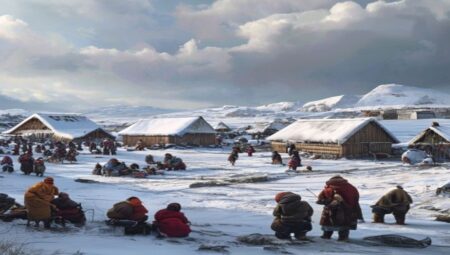
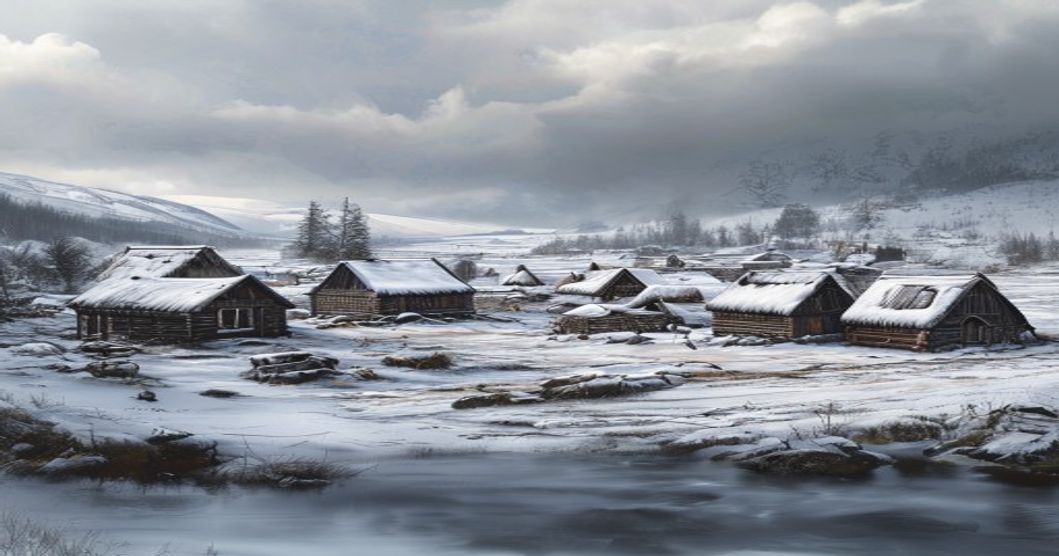
Coastal Sámi migrations followed fish-rich fjords and archipelagos, where stone foundations of semi-subterranean dwellings (goahti) indicate year-round occupation. Inland communities concentrated along salmon-running rivers like the Torne and Muonionjoki, utilizing log canoes and ice roads during winter months. Mountain tundra settlements relied on elevated camp sites near mineral deposits and grazing pastures, with archaeological strata showing continuous occupation from the Iron Age through the medieval period.
Archaeological Evidence of Early Sámi Communities
Excavations at key sites such as Komsa in Finnmark, Vettisfossen in Norway, and Lovi in Karelia have uncovered distinct material cultures. Pottery fragments display cord-impressed and comb-stamped motifs unique to northern foragers, while bone and antler artifacts demonstrate advanced toolcraft specialized for hide processing and hunting. Radiocarbon dating places the earliest unambiguous Sámi archaeological layers between 500 BCE and 400 CE, correlating with written Sami references in early Scandinavian chronicles.
The Evolution of Sámi Subsistence Strategies
Subsistence intensification among northern populations fundamentally transformed from opportunistic foraging to systematic resource management. The transition toward reindeer herding practices did not emerge abruptly but developed through centuries of semi-domestication, seasonal tracking, and territorial negotiation with neighboring agrarian groups.
Reindeer Domestication and Seasonal Transhumance
Genetic studies of domestic reindeer lineages (Rangifer tarandus) confirm that controlled herding originated in the Scandinavian Mountains approximately 1500 years ago, spreading rapidly across Lapland by the Viking Age. Archaeological faunal remains show a dramatic shift from wild caribou culling to selective breeding markers, including altered horn growth patterns and dental wear consistent with tethering. This innovation enabled seasonal transhumance routes spanning hundreds of kilometers, connecting winter pine forests with summer coastal pastures.
Fishing, Hunting, and Resource Management
Beyond reindeer, ancient Sámi economies relied on integrated resource networks. Fish weirs constructed from layered stone and timber appear in lake basins dating to the Early Medieval period, demonstrating engineered water management. Trapping stations for marten, fox, and beaver reveal sophisticated fur trade foundations that later connected Sámi merchants to Hanseatic commercial hubs. Botanical analysis of settlement layers shows intentional use of medicinal flora like arctic birch and bog myrtle, indicating specialized ethnobotanical knowledge.
Modern Archaeological and Genetic Insights
Contemporary research methodologies have revolutionized understanding of Sámi ancient settlement history. Interdisciplinary approaches combining paleogenomics, landscape archaeology, and indigenous oral mapping provide unprecedented resolution into prehistoric mobility patterns and cultural resilience.
DNA Analysis and Population Continuity
Whole-genome sequencing of Iron Age Sámi remains reveals high genetic differentiation from southern Scandinavian farmers, maintaining distinct haplogroups (U5b1b, C1c, N1c) until the 17th century. Admixture events with Finnish and Russian populations accelerated during the medieval period but remained geographically constrained to border zones. Ancient DNA studies also confirm that Sámi maternal lineages exhibit exceptional preservation of pre-agricultural European diversity, serving as a genetic archive of northern post-glacial expansion.
Preservation of Ancient Sámi Landscapes
Lidar scanning and ground-penetrating radar have mapped extensive Sámi cultural landscapes previously invisible to traditional excavation. These technologies reveal ritual sites, sacrifice structures (sieidi), and seasonal camp networks aligned with astronomical markers and migratory corridors. Conservation protocols now prioritize protecting these non-intrusive archaeological zones, recognizing that Sámi heritage exists as much in terrain configuration as in portable artifacts. Ongoing collaborative research between academic institutions and Sámi parliaments ensures that ancient Sámi settlement narratives remain grounded in both empirical data and indigenous epistemology.
Ancient Sámi Settlements and Migration Patterns
The **Sámi people** established permanent and semi-permanent settlements across **Fennoscandia** starting roughly **10,000 BCE**. These communities adapted to subarctic conditions through **seasonal mobility** rather than static urban planning. Archaeological layers reveal continuous occupation patterns spanning the **Bronze Age** through the **Middle Ages**. Settlement density correlates directly with **resource availability** and **glacial retreat patterns
Prehistoric Migration Routes and Timeline
Post-glacial corridors guided early groups toward **inland fells** and **coastal fjords**. **Beringian land bridge** descendants moved westward along the **Norwegian coastline**. **Ice-free refugia** in northern **Norway** and **Sweden** provided initial habitation zones. **Territorial boundaries** expanded during the **Medieval Warm Period** due to favorable growing conditions.
Archaeological Dating Methods for Campsites
Researchers rely on **radiocarbon dating** of **charcoal fragments** and **animal bone collagen**. **Dendrochronology** applies only to preserved **birch bark** and **wooden structural beams**. **Optically stimulated luminescence** measures sediment exposure in **tent rings**. **Stratigraphic analysis** separates **medieval occupation layers** from **Holocene deposits
Geographic Distribution of Campsites Across Sápmi
Settlement patterns follow **topographical gradients** and **hydrological networks**. **Coastal groups** occupied narrow **beach ridges** and **fjord inlets**. **Inland populations** clustered near **reindeer migration corridors** and **river valleys**. **Highland zones** hosted only temporary **seasonal hunting camps
Coastal Fishing vs. Inland Reindeer Herding Zones
**Coastal economies** depended on **cod fisheries** and **seal hunting** during winter months. **Inland territories** prioritized **reindeer husbandry** and **forest foraging**. **Transhumance routes** connected **winter pastures** to **summer grazing lands**. **Resource specialization** created distinct **toolkits** and **architectural styles** across regions.
Microclimate Selection Criteria for Camp Locations
Site placement minimized **wind exposure** and maximized **solar gain**. **South-facing slopes** provided critical **thermal buffering** during winter. **Proximity to water sources** dictated **camp positioning** regardless of terrain. **Natural windbreaks** from **rock formations** and **dense conifer stands** reduced **heat loss** in dwellings.
Settlement Infrastructure and Resource Management
Engineering solutions addressed **extreme cold** and **unstable permafrost**. **Circular tent foundations** anchored **hide coverings** with **stone weights**. **Drainage channels** diverted **meltwater** away from **sleeping platforms**. **Storage structures** elevated **food supplies** to prevent **rodent damage** and **moisture accumulation
Structural Engineering of Lavvu and Ground Dwellings
The **lavvu structure** relies on a **conical framework** of **sixty to eighty poles**. **Hide coverings** required **sewing with sinew threads** for **wind resistance**. **Central hearths** generated **updraft ventilation** that cleared **smoke through roof apertures**. **Ground dwellings** featured **sunken floors** that reduced **exposed surface area
Food Preservation Techniques and Trade Hub Locations
**Air-drying methods** converted **reindeer meat** into **stockable protein reserves**. **Fermentation pits** utilized **anaerobic conditions** to preserve **berries and fish**. **Trade networks** connected **inland producers** with **coastal merchants**. **Central exchange points** emerged near **river confluences** and **natural harbors
Archaeological Discoveries and Research Methodology
Modern excavations employ **systematic grid mapping** to document **stratigraphic shifts**. **Artifactual assemblages** undergo **compositional analysis** to trace **raw material origins**. **Isotopic studies** reconstruct **ancient dietary patterns** and **migration distances**. **Digital photogrammetry** creates **millimeter-accurate site models
Key Excavation Sites and Carbon-14 Validation
**Várjjatvatnet** and **Kautokeino** provide **continuous occupation sequences**. **Sápmi Heritage Sites** in **Finnmark** reveal **Neolithic toolkits**. **Radiocarbon calibration curves** correct for **atmospheric carbon fluctuations**. **IntCal20 datasets** align **regional samples** with **global chronologies
Remote Sensing and LiDAR Mapping of Buried Camps
**Airborne LiDAR** penetrates **forest canopies** to reveal **topographical anomalies**. **Ground-penetrating radar** detects **subsurface hearth features** without excavation. **Thermal imaging** identifies **frost heave patterns** linked to **buried structural remains**. **Satellite multispectral data** highlights **vegetation stress** over **ancient roadways
Preservation Status and Legal Framework
Legal protections classify **Sami archaeological zones** as **protected cultural landscapes**. **National heritage agencies** enforce **non-invasive survey mandates**. **Indigenous land rights** grant **co-management authority** over **excavation permits**. **Funding allocations** prioritize **preventive conservation** over **reactive restoration
UNESCO Designation and National Heritage Protection
**Laponia** holds **UNESCO World Heritage status** for **cultural-natural synergy**. **Norwegian Antiquities Act** prohibits **unauthorized digging** in **designated zones**. **Swedish Heritage Act** mandates **developer consultation** before **infrastructure projects**. **Finnish Cultural Environment Agency** maintains **digital site registries
Climate Threats and Soil Erosion Mitigation Strategies
**Permafrost thaw** accelerates **organic artifact degradation**. **Increased precipitation** triggers **slope failures** in **hillside settlements**. **Mitigation strategies** include **geotextile stabilization** and **drainage redirection**. **Controlled burning** reduces **undergrowth pressure** on **turf structures
Frequently Asked Questions
What is Ancient Sami Settlements in Scandinavia?
Ancient Sami settlements in Scandinavia refer to the historical communities and dwelling sites established by the Indigenous Sami people across the northern regions of Norway, Sweden, Finland, and the Kola Peninsula. These settlements were traditionally organized around reindeer herding, fishing, hunting, and seasonal migrations, with dwellings ranging from lavvu tents to semi-subterranean sod houses.
Key facts about Ancient Sami Settlements in Scandinavia
Key facts include their adaptation to Arctic and sub-Arctic environments, the use of sustainable seasonal migration patterns, the central role of reindeer in their economy and culture, the construction of specialized dwelling types like the goahti, and their rich oral traditions and spiritual practices tied to the natural landscape.